Customers often ask me where our wheat comes from and what happens to it along the way from growing in a field to arriving at the mill ready to be turned into organic flour. So, here’s the story:
We have had the privilege to work with Richard Morris and his team at Home Farm, Wimople for the last five years. The farm is part of the National Trust Wimpole estate. Richard runs a mixed organic farm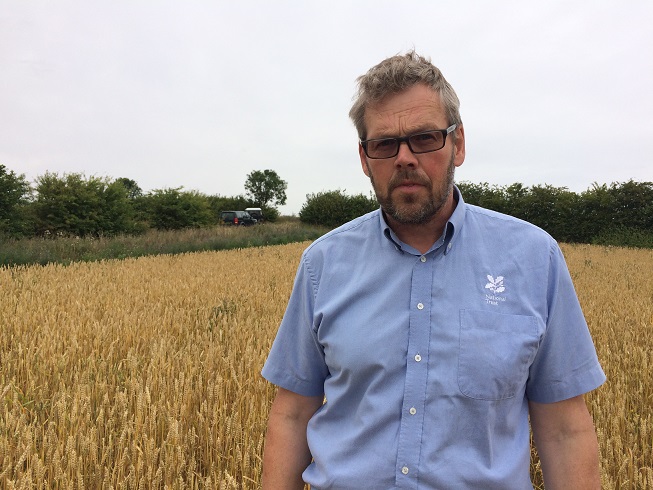 including producing over 100 acres of wheat. For the last few years, he has grown the variety Mulika, a relatively recently cultivated variety which is related to Paragon. Mulika grows well under organic conditions and Richard has been able to grow wheat with a protein content of >12%, a key factor required for milling wheat. Wheat with less than 12% protein is unlikely to make good bread as the dough structure does not have enough gluten to hold the bubbles of carbon dioxide produced by the yeast fermentation process.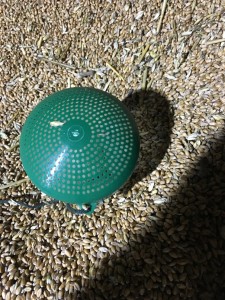
When the wheat is ripe, typically in early September, Richard and his team combine the wheat and store it in the Home Farm grain store. It’s important that the wheat rests for a period to allow the organic matter which is harvested with the grains to dry off and the bugs and insects that come in with the harvest to disappear out of the grain heap. The photo to the right shows the monitors we use to ensure that the harvest is free of weevils and beetles before it is moved off farm for the next stage of the process.
Once the grain is ready, it is moved to Hammonds End Farm, Harpenden where Howard and Stuart Roberts dry, clean, bag and store the wheat ready for transportation to the mill.
Arrival & Drying
When the wheat arrives, it is still wet and full of chaff, seeds, bits of straw.
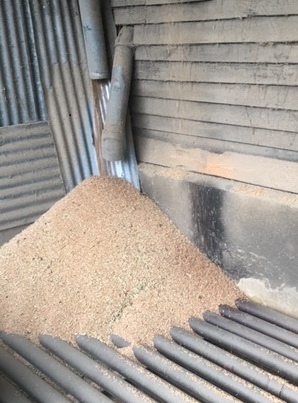
Here you can see the wheat as it is loaded into the dryer, an oil fired drying machine which pushes warm air through the wheat reducing the moisture from around 17% at the point it arrives at Hammonds End to around 12-13%, the ideal moisture content at which to store wheat to keep it in fantastic condition!
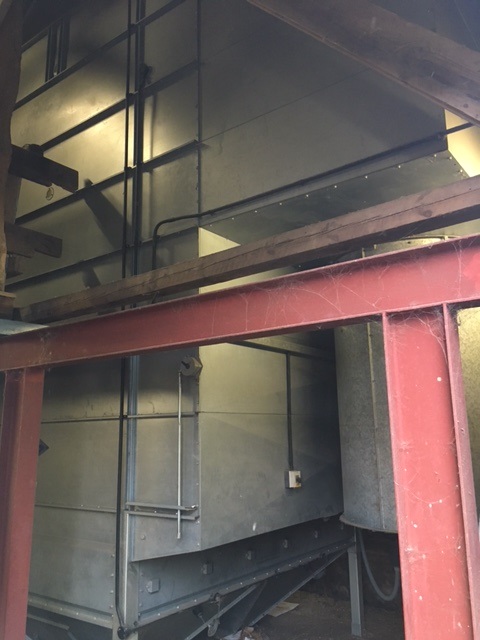
The machine is huge – a great place to hide on a cold winters’ day with the warm air coming off the wheat stack!
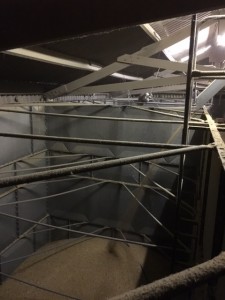
Once the wheat has been processed, it is stored ready for cleaning, the process used to remove everything apart from the large quality grains that will be milled into your flour!
Cleaning & Bagging
The final stage of the process before the wheat is stored ready for shipment involves cleaning the wheat to remove the chaff, straw, seeds, dust and muck that is harvested along with the grains of wheat. We also need to remove the small shriveled grains that are no good for milling and to polish the wheat grains to ensure they are in tip-top condition ready to mill. All this is done in a machine called a Gravity Table Separator. The wheat is passed through a series of table sieves which remove all the unwanted bits and pieces:
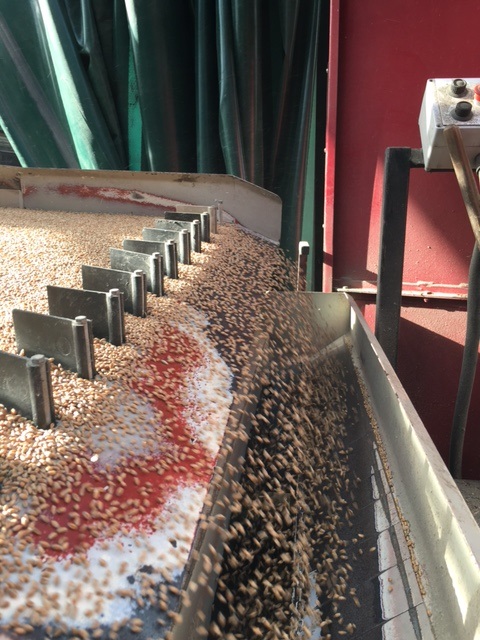 Here you can see the wheat being shaken across one of the sieves, cleaning it as it goes. This process is critical as it ensures there is no chaff in the wheat sample which we mill.
The final stage is to bag up the wheat ready for palletised storage until we are ready to receive the wheat at Fosters Mill. Given the fact Fosters Mill is a small tower mill, we are only able to accept wheat in 25kg sacks. With 40 sacks to a metric tonne, we get through a lot of paper sacks! You’ll be pleased to know they are re-used and then recycled..
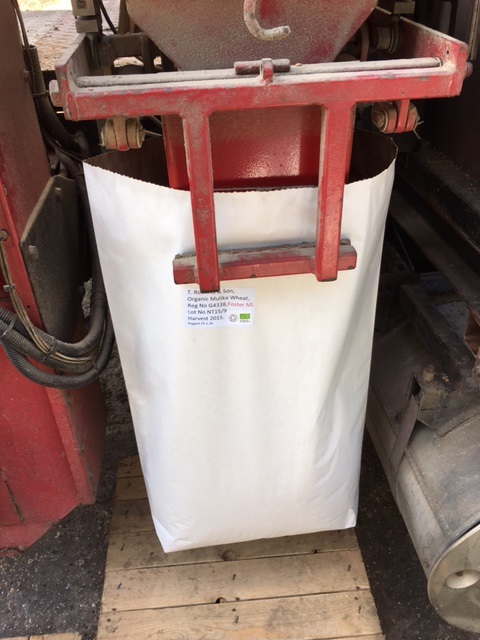 We mill over 25 tonnes of wheat each year. We are really grateful for the help and support we get from Richard and his team at Home Farm and from Stuart, Howard and Chas at Hammonds End Farm. It’s a real team effort to get our wheat ready for milling, one which ensures everything is set for milling our delicious Prior’s Flour!
The Mulika wheat is used to produce:
Cambridge White
Cambridge Wholemeal
Wheaten Meal
Malted Maltiseed